ATT fidelity
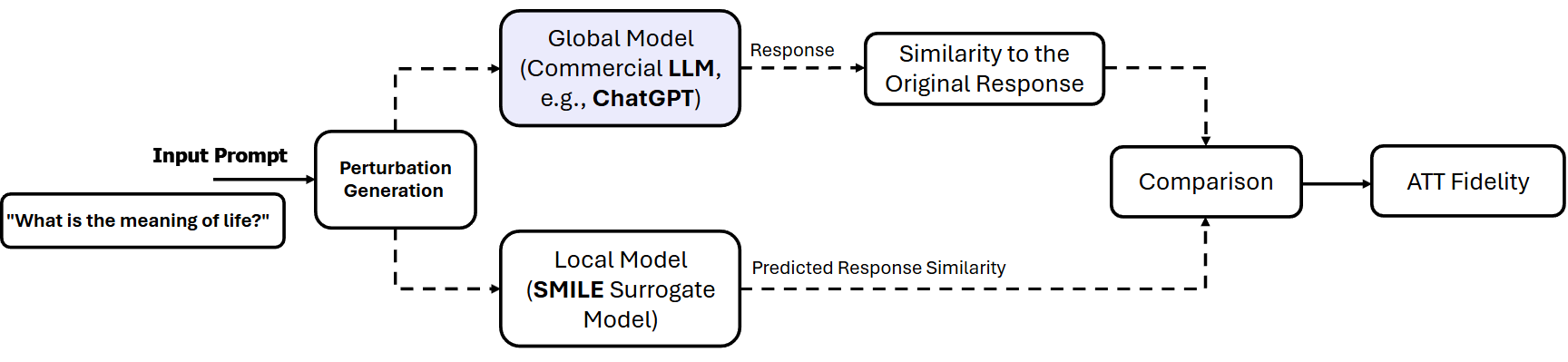
ATT fidelity asks whether the interpretable local surrogate reproduces the black-box model's response within the perturbation neighbourhood used to generate the explanation.
It evaluates the explanation mechanism, not the original model's task accuracy. A classifier can be accurate while its local explanation has poor fidelity, and a highly faithful surrogate can accurately approximate undesirable black-box behaviour.
General formulation
For perturbations (z_i), let:
- (y_i) be the black-box response or response shift;
- (\hat{y}_i) be the local surrogate prediction;
- (w_i) be the locality weight assigned to the perturbation.
ATT fidelity compares (y_i) and (\hat{y}_i), with local samples receiving the weights specified by the explanation method.
What changes by modality
| Modality | Black-box target (y) | Surrogate target (\hat{y}) |
|---|---|---|
| Image classification | Predicted-class probability after masking superpixels | Probability shift predicted from the retained-superpixel vector |
| LLM / gSMILE | Semantic or distributional output shift after prompt perturbation | Output shift predicted from retained or altered tokens |
| Image editing | Perceptual, embedding, structural, or semantic change in the edited image | Change predicted from instruction-token or condition perturbations |
| Point cloud | Class, detection, or segmentation response after point/cluster perturbation | Response predicted from retained points, clusters, or parts |
| KG-RAG | Answer or semantic-response shift after removing graph evidence | Shift predicted from retained entities, relations, paths, or retrieved items |
| ConceptSMILE | Concept-confidence or concept-response shift after evidence perturbation | Concept-response shift predicted from the perturbation vector |
The metrics may have the same names across modalities, but their raw values are only comparable when the response variables and scaling are comparable.
Metrics currently implemented in XWhy
XWhy provides RegressionMetrics.calculate() and the immutable RegressionMetricResult container.
from xwhy.metrics import RegressionMetrics

fidelity = RegressionMetrics.calculate(
    y_true=y_target,
    y_pred=y_pred,
    weights=locality_weights,
    num_features=num_interpretable_features,
)

print(fidelity.weighted_r2)
print(fidelity.weighted_adj_r2)
print(fidelity.weighted_mse)
print(fidelity.weighted_mae)
The function currently returns:
| Field | Interpretation | Preferred direction |
|---|---|---|
weighted_r2 |
Weighted coefficient of determination | Higher |
weighted_adj_r2 |
Weighted R-squared adjusted for feature count | Higher |
weighted_mse |
Locality-weighted squared prediction error | Lower |
weighted_mae |
Locality-weighted absolute prediction error | Lower |
mean_loss |
Difference between mean target and mean prediction | Lower |
mean_l1_loss |
Mean absolute residual | Lower |
mean_l2_loss |
Mean squared residual | Lower |
weighted_l1_norm |
Weighted absolute residual norm | Lower |
weighted_l2_norm |
Weighted squared residual norm | Lower |
Reading fidelity from an explanation result
Both currently implemented explainers attach the fidelity result to result.metrics.
result = explainer.explain(instance)

print(result.metrics)
print(result.metrics.weighted_r2)
print(result.metrics.weighted_mae)
The result also stores the arrays used for fidelity evaluation:
y_target = result.raw_data["y_target"]
y_pred = result.raw_data["y_pred"]
weights = result.raw_data["weights"]
A fidelity plot can be generated from an XWhy result:
result.plot(show=True)
LLM example
In gSMILE, prompt perturbations are represented by token-retention vectors. The black-box target is the semantic output shift caused by each perturbed prompt, and the local surrogate predicts that shift from the interpretable token vector. The paper evaluates alignment using R-squared variants and error-based metrics.
Interpretation requirements
Report fidelity together with:
- the response variable and its scale;
- the perturbation count and generation procedure;
- the locality distance and weighting kernel;
- the surrogate family and feature count;
- whether model outputs were deterministic;
- the distribution of locality weights;
- both an accuracy-based and an error-based fidelity metric.
High fidelity is local and conditional
A high score only demonstrates that the selected surrogate approximates the sampled black-box responses under the stated neighbourhood and weighting scheme. It does not establish global equivalence, causal validity, attribution accuracy, stability, consistency, or human usefulness.
Research basis
- gSMILE defines ATT fidelity for LLM token attribution using local surrogate agreement.
- ConceptSMILE applies surrogate fidelity to concept-response behaviour and shows that fidelity can differ by concept pathway and locality weighting.