Explaining LLM responses
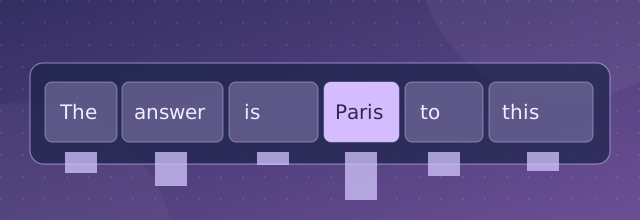
LLM explainability · XWhy explainer
Imagine asking a language model to summarise a report. If its answer changes when a single condition is removed from the prompt, that condition deserves attention. But which prompt terms mattered most to the response, and how reliably can we estimate their influence?
Perturb the prompt carefully
XWhy's LLMExplainer changes selected parts of a prompt and measures how those changed prompts relate to a reference response. It fits a local model to produce estimated token contributions to its response-alignment score. This is a practical way to explore sensitivity around the chosen prompt.
For instance, an explanation might show that a condition such as “include only 2025 figures” is influential. A useful follow-up is to remove or rephrase that condition and compare the observed behaviour. The contribution alone does not tell us what computation happened inside the model.
Match the claim to the measurement
The current documented workflow queries the provider for the original response and uses a semantic-distance measure in the local comparison. Its token contributions therefore describe the configured response-alignment approximation for the original prompt, rather than a complete causal account of how the model generated every output token. A prompt heatmap is not a view into private chain-of-thought.
Language model outputs can vary across runs and providers. Report the provider, model version, prompt, embedding and distance settings, perturbation choices and local fit. If a finding is used in an assessment, check whether it survives a few sensible paraphrases and whether the model's observed answer changes in the expected way.
The LLM explainer guide and worked LLM example describe the available interface and interpretation boundary. The related gSMILE research preprint provides additional background.